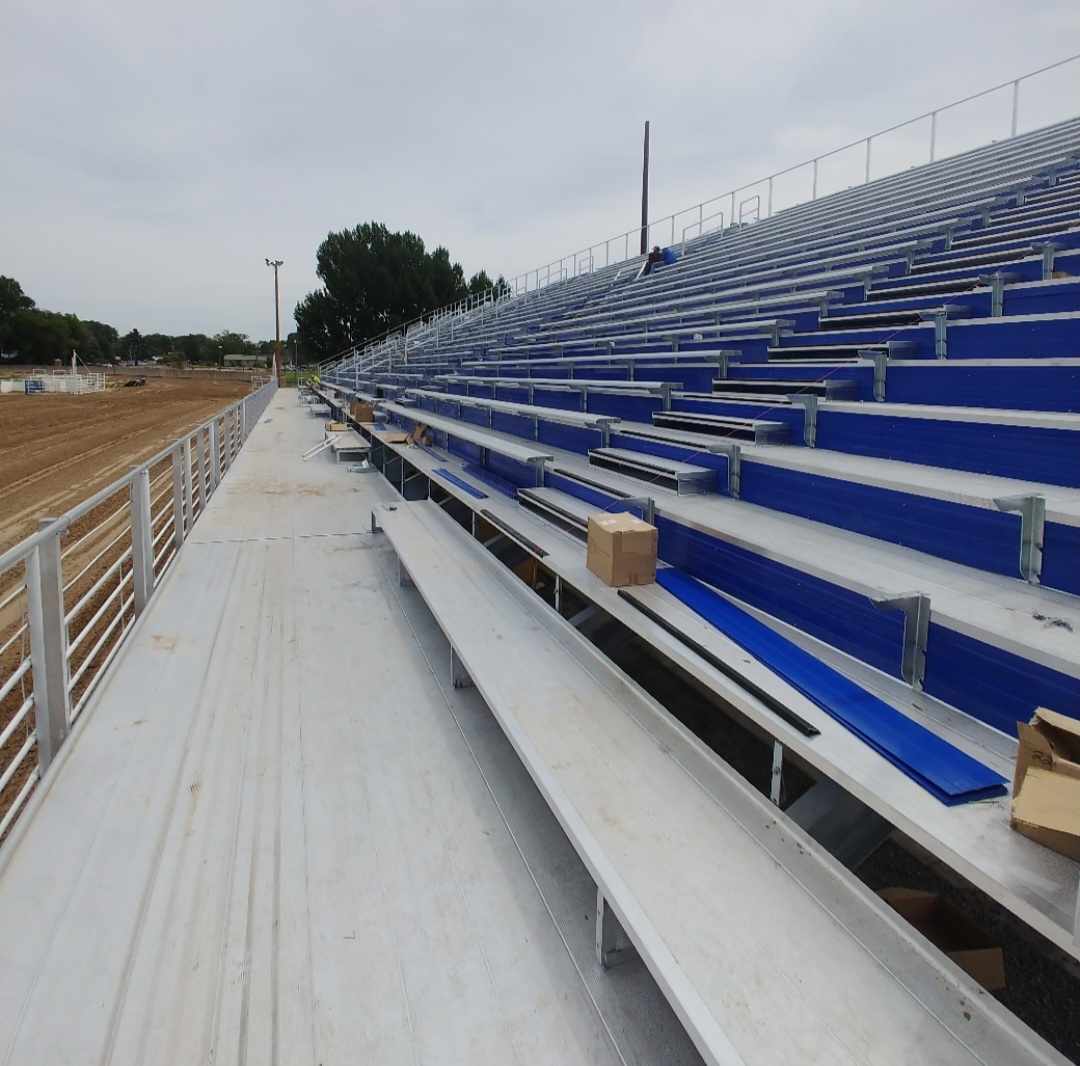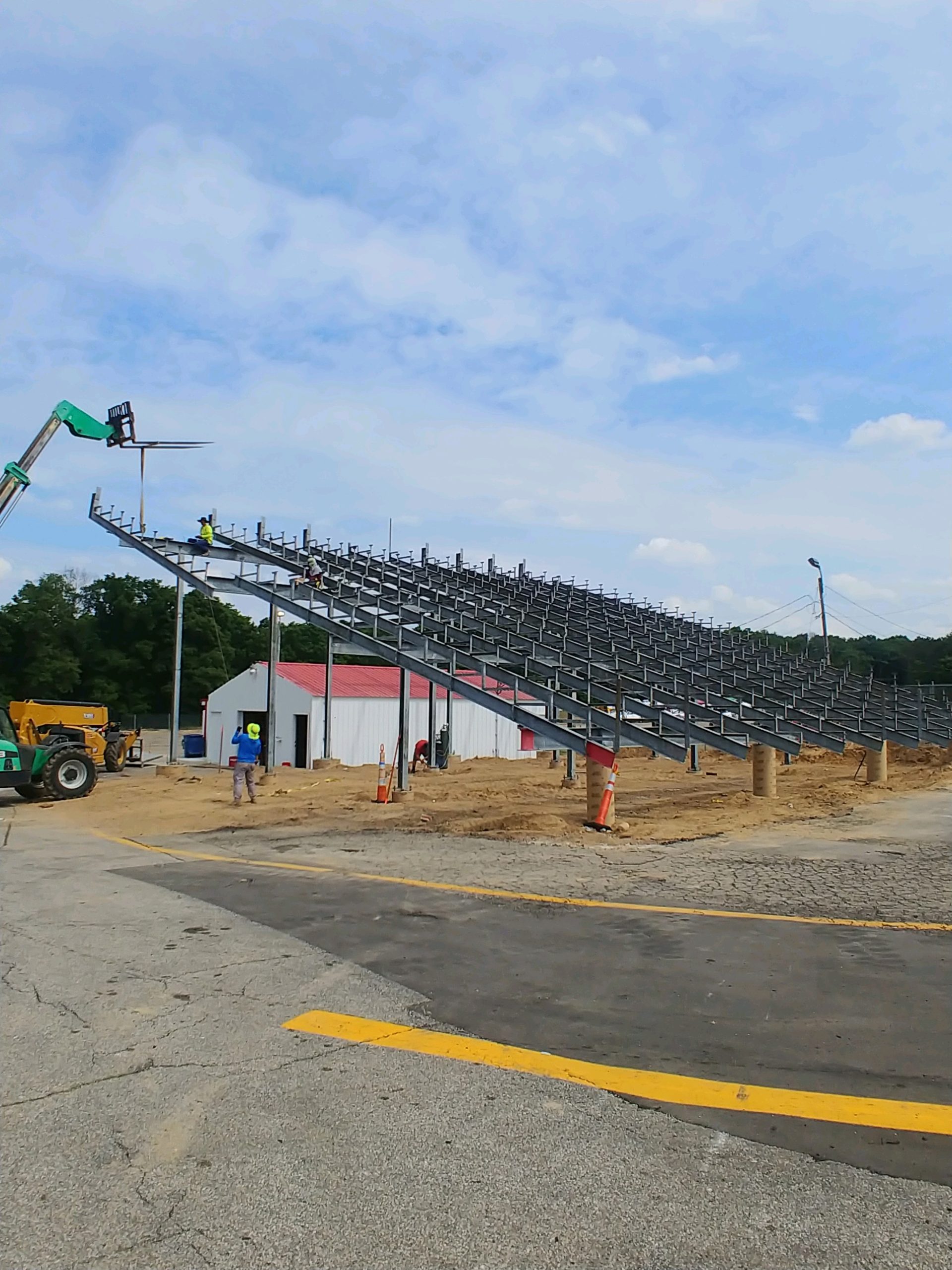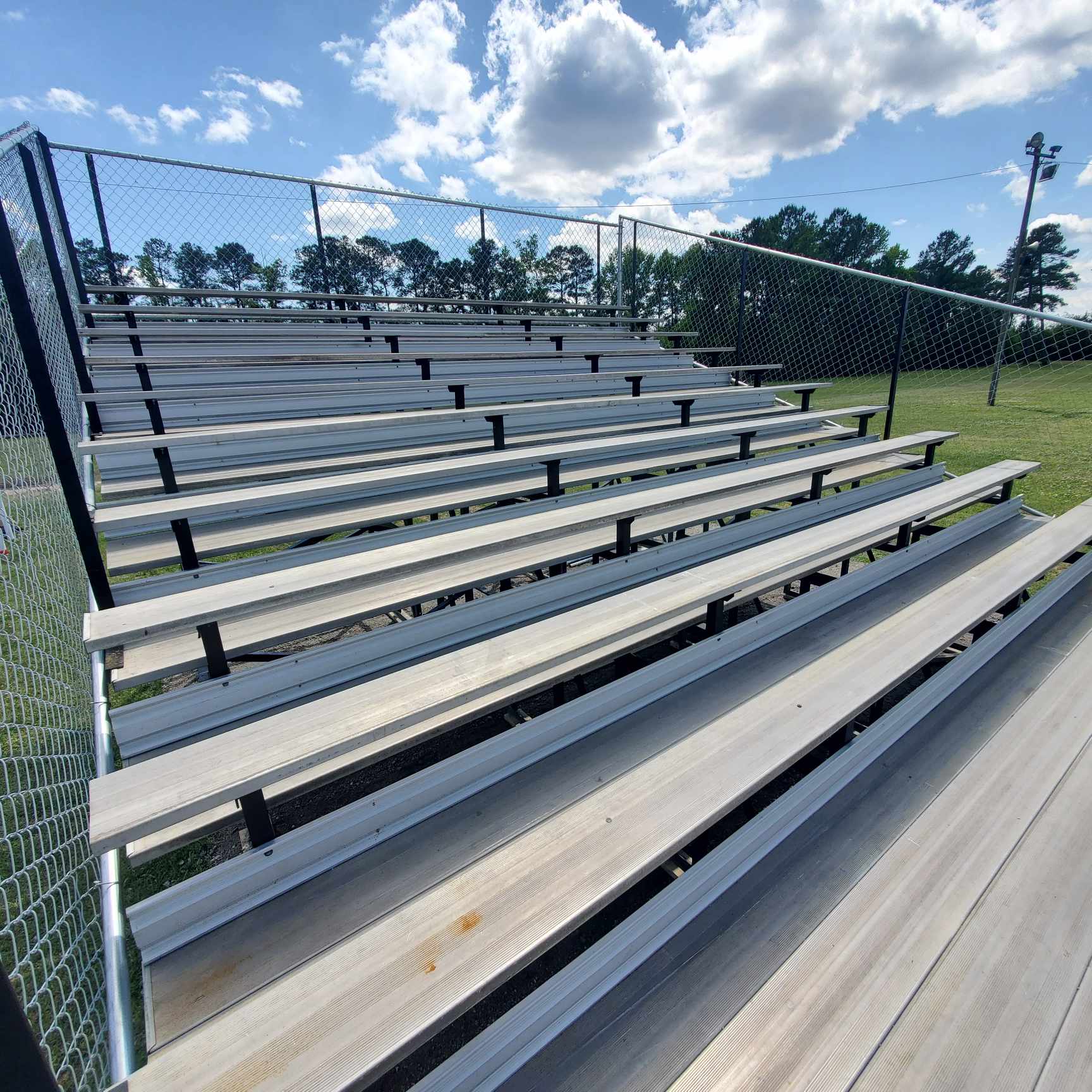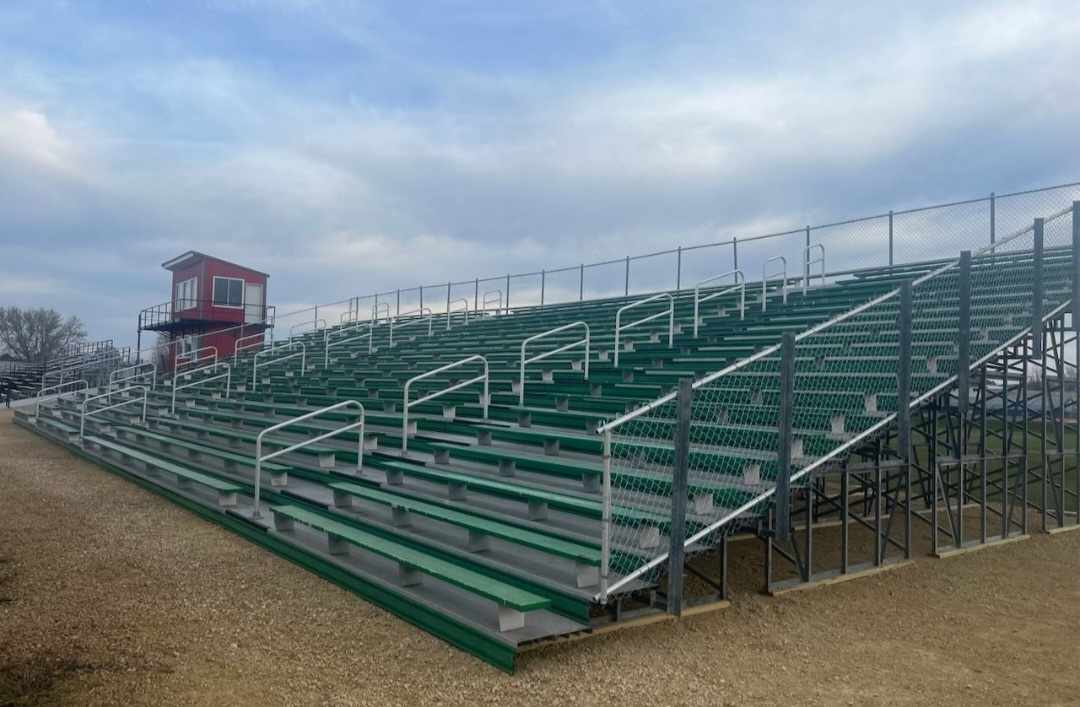
People use the words interchangeably, and the building code does not help: the International Building Code defines bleachers and grandstands the same way, as tiered seating on a dedicated structure, two or more rows high. In practice the industry draws a line, and it matters for your budget, your site and your schedule.
What we mean by each
| Bleacher | Grandstand | |
|---|---|---|
| First row | At or near grade (a step up) | Elevated, typically 4 to 8 feet up, on a front walkway |
| Rows | 3 to 15 | 10 to 40 |
| Structure | Aluminum angle frame or I-beam | Galvanized steel columns and bracing with aluminum deck |
| Seating | Bench, contour, backrest | Bench and chair sections; suites on larger stands |
| Access | Front rows and end aisles | Ramps, stair towers, vomitories; elevator on larger stands |
| Under the stand | Open or screened | Usable: concessions, restrooms, storage, team rooms |
| Foundation | Pad or small footings | Engineered spread footings or piers at every column |
| GB Series | GB-A, GB-I, GB-P | GB-E, GB-S, GB-R |
When a bleacher is the right answer
A ground-level bleacher is the right call more often than people expect. Visitor sides, baseball and softball, soccer and lacrosse, practice fields, track finish lines, fairground arenas, gyms: anywhere the field is at the same grade as the stand and the crowd is under a thousand or so, a bleacher does the job at a fraction of the cost, with faster installation and far less site work. A 10-row I-beam bleacher that runs 150 feet seats a thousand people and goes in on pad footings.
When you need a grandstand
- Something is in the way. A fence, a dugout, a track wall, a catch fence, a warm-up area. If the front row cannot see the near side of the action, elevate it.
- You want the space underneath. Concessions, restrooms and storage under the stand save a separate building and put them where the crowd already is.
- The stand is tall enough that getting in and out is the problem. Above about 15 rows, a front walkway, stair towers and vomitories through the stand make filling and emptying it faster and safer than climbing from the front.
- Chairs, press boxes, cameras, suites. All of them live more comfortably on a grandstand frame.
- It is the home side. Elevated stands say something about a program, and districts and colleges tend to want that at the front door of the stadium.
What the difference costs you
Per seat, a grandstand costs more than a bleacher, and the gap is mostly in the understructure and the foundations rather than the seats. An elevated stand puts real load on individual columns, so each one sits on an engineered footing, which means a geotechnical report, a foundation design and a concrete contractor on the schedule. It also brings an accessible route to the first row (a ramp or a lift), stair towers and, on bigger stands, an elevator. None of that is a reason not to build one; it is the reason to know which one you are building before the budget is set. What drives the cost of a grandstand goes through the line items.
A low-elevated I-beam stand, with the first row two or three feet up on a short walkway, clears a 4-foot fence and keeps the foundations simple. It is the most common answer for a baseball home side behind a backstop.
Bleachers, stands and benches: the other words people use
Search for seating and three more words turn up. Here is how they line up with the two above.
- Stands is the everyday word for either one. Bleachers are stands, and so is a grandstand; most people say the stands when they mean the seats on the home side.
- A bench is a single row of seating, usually a team bench on the sideline or in the dugout. A bleacher is two or more rows on a tiered frame, which is what puts it under the building code and ICC 300.
- Grandstand bleachers usually means a big bleacher, often an elevated one. In our terms it is a bleacher or a grandstand depending on where the first row sits.
Not sure which side of the line you are on? Send us the site and the crowd and we will tell you, with a drawing.