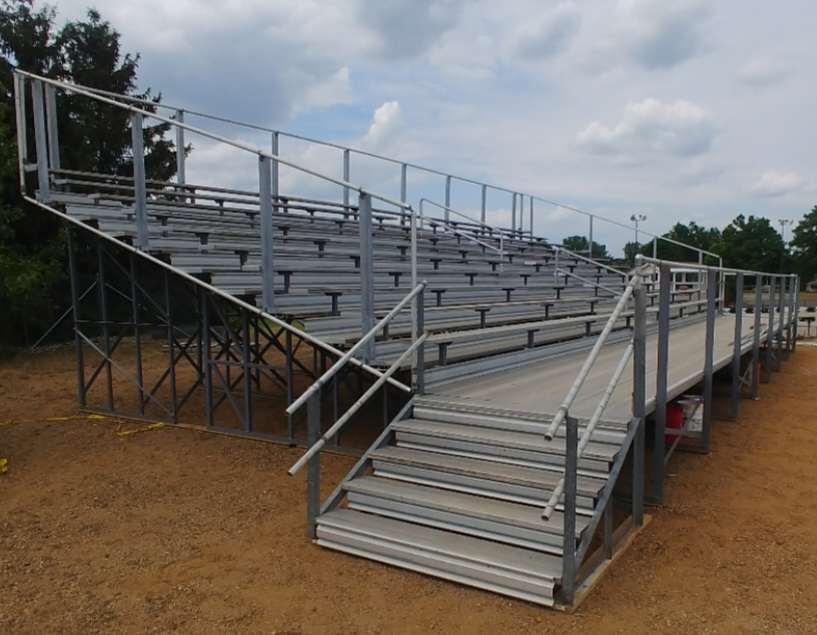
Baseball Bleachers
Seating behind the plate and down the lines, laid out around the backstop, the dugouts and the netting, from five-row bleachers at the practice field to elevated grandstands at the championship diamond.
Where the seats go on a diamond
Baseball and softball crowds sit behind home plate and along the first- and third-base lines, close to the game. That usually means several shorter stands placed around the diamond, not one long run.
- Behind the plate: GB-A angle-frame bleachers, or a GB-E elevated grandstand that lifts the first row over the backstop wall and the dugouts
- Down the lines: GB-A angle-frame bleachers in 15-foot sections, set where the field’s netting protects them
- Championship and college fields: GB-I I-beam or GB-E elevated stands with a press box, chairback rows and a canopy
- Tournament complexes: GB-A angle-frame bleachers at every field, with GB-P portable units for overflow

The backstop and netting
Backstop height and protective netting decide where the first row can sit and how high it has to be. We lay the stand out with the netting, not after it.
Shade for day games
Afternoon games and doubleheaders are long in the sun. A partial or full canopy over the rows behind the plate is an option on I-beam and elevated stands.
Getting to the seats
Accessible seating with companion seats, on an accessible route from the parking lot. Angle-frame bleachers offer front-entry rows and wheelchair cut-outs.
Baseball bleachers
A baseball diamond is the bigger field, with 90-foot bases and a 60-foot, 6-inch pitching distance from high school up, so the crowd spreads farther around it. Home fields at high schools and colleges usually put an elevated stand with a press box behind the plate and bleacher sections down both lines.
Typical build: a GB-E elevated grandstand or GB-I I-beam stand behind home plate, with GB-A angle-frame sections down the first- and third-base lines.
Softball bleachers
Fastpitch softball is played on a tighter diamond, with 60-foot bases and a 43-foot pitching distance at the high school and college level, so fans sit closer to the plate and shorter stands work well. Softball fields and tournament complexes usually seat the crowd behind the plate and along the lines in ground-level bleachers, with portable units added for tournament weekends.
Typical build: GB-A angle-frame bleachers behind the plate and down the lines, GB-P portable units for overflow, and a GB-E elevated grandstand where a college or championship field needs one.
Planning a softball complex? See softball bleachers for portable, tournament and stadium options.
Typical builds by field
We plan bench seating at 18 inches per person, so every 15-foot section seats 10 people per row. Chairs take more room, about 10 to 15 percent fewer seats for the same length.
| Field | Typical build | Notes |
|---|---|---|
| Practice field or youth diamond | GB-A Angle Frame, 3 to 5 rows | One or two 15-foot sections behind the plate, on a pad or stone base |
| High school varsity | GB-A behind the plate and down the lines | Matched planks and rails across baseball and softball |
| College or championship field | GB-E or GB-I | Press box, chairback rows behind the plate, canopy |
| Tournament or multi-field complex | GB-A at every field, GB-P for overflow | Repurposed aluminum to stretch the budget |
Baseball and softball questions
How many rows do baseball bleachers need?
Often fewer than you expect. Crowds spread around the diamond, so several short stands behind the plate and down the lines can seat more people, with better views, than one tall stand. Start with the crowd on your biggest day and our row-count guide.
Can fans see over the dugouts?
Yes, with an elevated stand. A GB-E grandstand puts the first row at walkway height, which clears fences and dugouts.
Can you add shade?
Yes. Partial or full canopies over reserved sections are an option on I-beam and elevated stands.
Can bleachers move between fields?
Yes. GB-P portable bleachers come in tip-and-roll units of 3 to 5 rows and towable units of 5 to 10 rows, built to the same safety standard as a permanent stand.
Can you add seats to our existing field bleachers?
Yes. We add rows and sections to existing stands, and replank or retrofit older ones. See bleacher renovation.
Do you build press boxes for baseball fields?
Yes. A small announcer and scorer’s box behind home plate, on an I-beam stand or a raised grandstand, with power and data run to it. See press boxes.
Planning guides
- How many rows do I need?
Turn the crowd on your biggest day into rows, length and seats.
- Site prep checklist
Survey, soils, drainage, utilities and access before the stand arrives.
- New or repurposed aluminum?
When refurbished seating is the smarter buy, and what we check before a plank is reused.
Seating a diamond?
Tell us the field, where the crowd sits today and the crowd on your biggest day. We will come back with a layout and a number.